From “Cool Waters” to Silicon Savannah: The Remarkable History of Nairobi
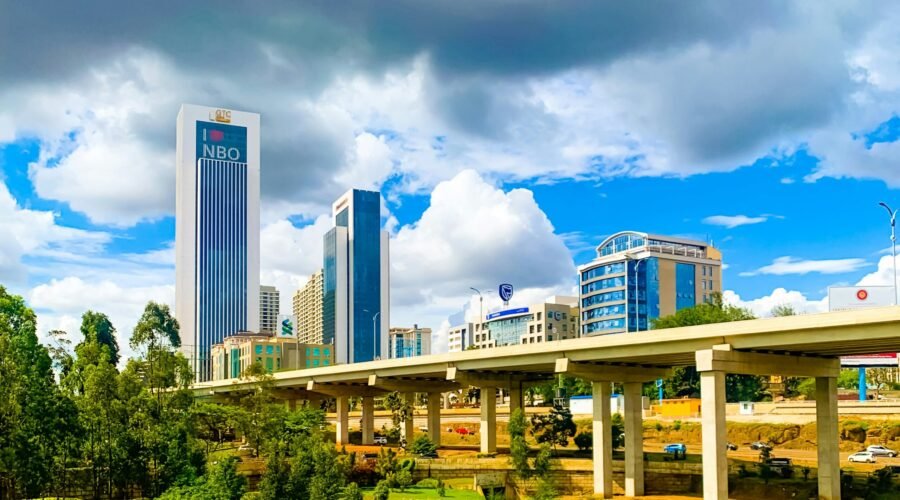
When you stand amidst the gleaming glass skyscrapers of Upper Hill or navigate the bustling traffic of Moi Avenue, it is hard to imagine that just over a century ago, Kenya’s capital did not exist.
Unlike ancient global cities that took millennia to evolve, Nairobi was born almost overnight. Known affectionately today as the “Green City in the Sun,” Nairobi’s journey from a brackish swamp to East Africa’s most dominant economic and diplomatic hub is a fascinating story of infrastructure, resilience, and transformation.
Here is how a temporary railway camp at “Mile 327” became the beating heart of East Africa.
1. Pre-1899: Enkare Nyrobi – The Place of Cool Waters
Before it was a concrete jungle, the land Nairobi sits on was an expansive network of high-altitude grasslands, papyrus swamps, and watering holes.
The nomadic Maasai people seasonally used the area for grazing, calling it Enkare Nyrobi (or Enkare Nairobi), which translates to “the place of cool waters”. It was a neutral ground shared geographically with the agriculturalist Kikuyu and sedentary Akamba communities. There were no permanent stone buildings—just the quiet whisper of streams flowing from the nearby Ngong Hills.
2. 1899–1905: The “Accidental” Railway Town
Nairobi owes its concrete foundations entirely to the construction of the Uganda Railway. In 1899, British engineers building the rail line from the coastal port of Mombasa to Lake Victoria reached Mile 327.
They needed a staging post before tackling the daunting engineering challenge of ascending the steep Great Rift Valley escarpment. Chief Engineer George Whitehouse chose this swampy plain because it was flat, had ample water from local rivers, and offered a cooler climate.
What was meant to be a temporary camp of tents and timber shacks quickly exploded. Thousands of Indian laborers (who stayed to establish the famous Indian Bazaar), British administrators, and African workers flocked to the site.
- Fun Fact: The settlement was so hastily assembled that in 1900, a major outbreak of the bubonic plague forced the authorities to burn the entire town to the ground and rebuild it from scratch!
3. 1907–1963: The Colonial Capital and Divided Spatial Lines
Realizing Nairobi’s strategic importance, the British colonial government officially transferred the capital of the British East Africa Protectorate from Mombasa to Nairobi in 1907.
As the city grew, colonial urban planning explicitly enforced racial and socio-economic segregation. The leafy, low-density western suburbs (like Karen and Muthaiga) were reserved for Europeans,
commercial districts were occupied by Asian traders, and overcrowded, high-density zones in the east (Eastlands) were designated for African laborers. This era also saw the rise of Nairobi’s first informal settlements—such as Kibera, which initially housed Sudanese Nubian soldiers.
By the 1950s, Nairobi became a central stage for political defiance during the Mau Mau Uprising, as Kenyans pushed back fiercely against British rule, setting the stage for liberation.
4. 1963–Present: Independence and the Rise of the Silicon Savannah
On December 12, 1963, Kenya gained independence, and Nairobi proudly took its place as the capital of the new Republic.
The post-independence era was marked by massive Africanization. Colonial street names were replaced with the names of freedom fighters and African statesmen—Government Road became Moi Avenue, and Hardinge Street became Kimathi Street. Iconic architectural marvels like the Kenyatta International Convention Centre (KICC) opened in 1973, forever shifting the city’s skyline.
The city’s global footprint solidified when it became home to the United Nations Environment Programme (UNEP) headquarters in Gigiri, making it the only UN headquarters located in the Global South.
Nairobi Today: A Beautiful Chaos
Today, Nairobi is a thrilling juxtaposition of worlds. It is the only capital city in the world that boasts a fully functioning safari park—the Nairobi National Park—where you can photograph black rhinos roaming freely with a backdrop of city skyscrapers.
Simultaneously, Nairobi has earned the moniker “Silicon Savannah,” serving as Africa’s premier hub for tech innovation, mobile money (M-Pesa), and multinational corporate headquarters.
From a simple swampy rail depot to a global powerhouse, Nairobi’s history proves that its spirit is just like its people: fast-paced, resilient, and continuously evolving.